
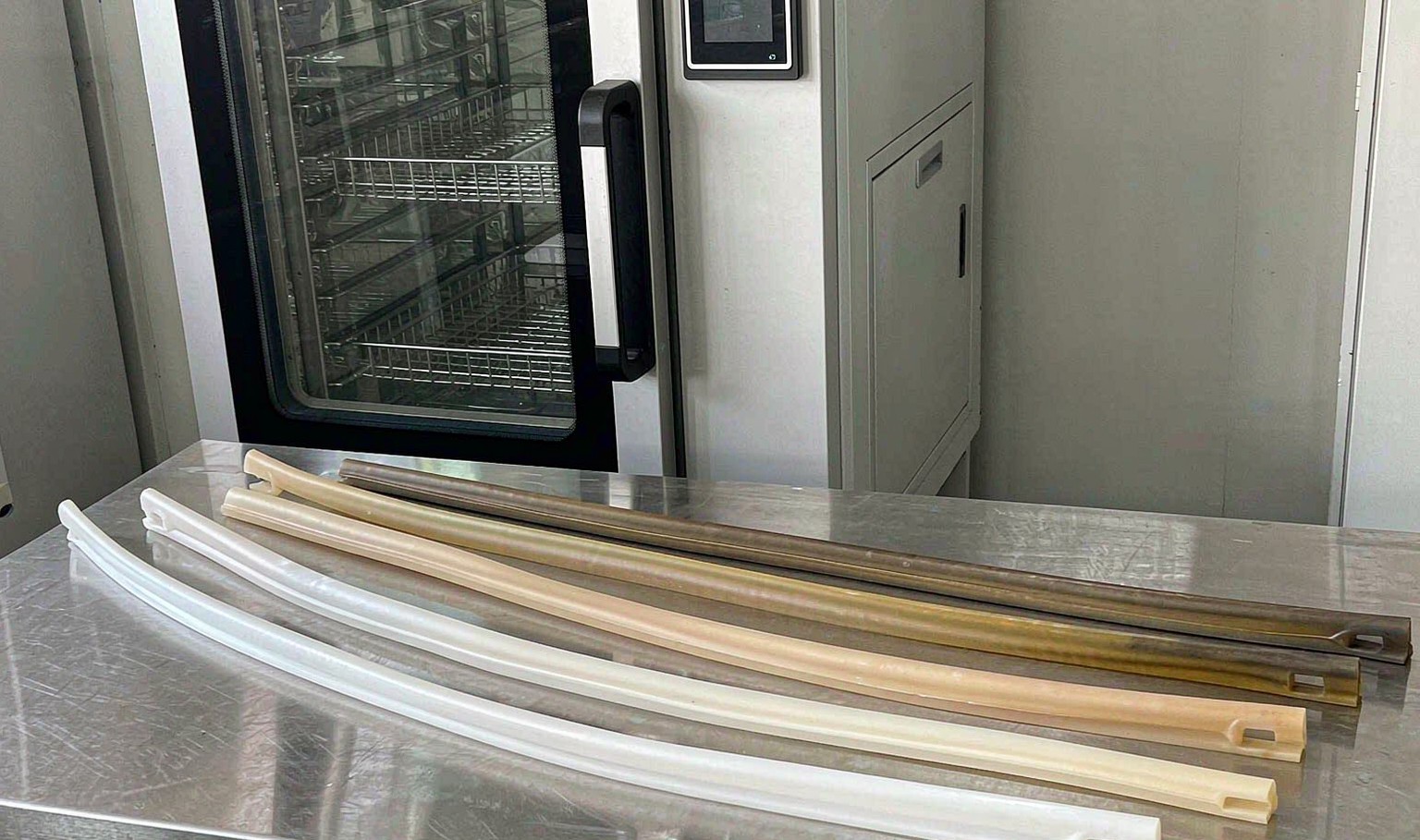
- 1. Yellowing is oxidation, and it is measurable early
- 2. Two mechanisms, and they respond to different fixes
- 3. Post-cure helps, and not for the reason people think
- 4. The additive is the other half, and it is not interchangeable
- 5. Telling yellowing from staining
- 6. Specifying colour fastness so it can be checked
Yellowing is oxidation, and it is measurable early
Silicone is sold as heat resistant, and it is, but heat resistance is not colour stability. A silicone part in an air oven at 200 C will hold its mechanical properties for weeks and turn yellow in days. The two are separate processes and they are usually confused.
The colour comes from oxidation of the polymer backbone and of the organic groups attached to it. Oxygen attacks the methyl groups, forms hydroperoxides, and those decompose into carbonyl compounds and conjugated structures that absorb in the blue end of the spectrum. What the eye sees is the complement: yellow.
The reaction needs oxygen, so it is a surface process first and a bulk process later. A 2 mm section yellows from the outside in, which is why a thick part looks less yellow than a thin one from the same batch, and why a cut face is lighter than the surface beside it.
The useful consequence is that yellowing is measurable before it is visible. A yellowness index of 5 is barely perceptible; 10 is visible against a white reference; 18 is a complaint. Instruments read all three, and the measurement takes a minute.
Two mechanisms, and they respond to different fixes
There are two routes to a yellow part and they are worth separating, because the fix is different. The first is thermal oxidation: heat plus oxygen, no light, and it happens in an oven, in a hot engine bay, or in a part that is post-cured too long at too high a temperature.
The second is UV. Ultraviolet light breaks the same bonds by a different route and produces the same chromophores, but it does it at the surface only and it does it at room temperature. A part on a windowsill yellows where a part in a dark oven at the same temperature does not.
On a measured 200 C air oven test, the standard compound went from a yellowness index of 2.1 as moulded to 5.8 at 24 hours, 9.6 at 48, 13.4 at 72, 16.2 at 96, 17.9 at 120 and 18.9 at 168 hours. The curve is steep for three days and then flattens, which is the signature of a surface reaction running out of fresh material to attack.
A UV test looks different. The index climbs quickly in the first 100 hours of exposure and then continues slowly, because the reaction keeps finding new surface as the top layer degrades. A part that passes 168 hours in an oven can still fail 200 hours of UV, and the reverse is also true.

Post-cure helps, and not for the reason people think
A post-cure is usually specified to remove volatiles, and it does. It also improves colour stability, and the mechanism is indirect: a part that is fully cured has fewer residual reactive sites, so there is less for oxygen to attack. The post-cure is not adding protection, it is removing a vulnerability.
On the measured set, a post-cure at 200 C for four hours took the 168 hour index from 18.9 to 12.8. That is a 32 percent improvement for four hours of oven time, which is a good return and a common specification.
There is a limit and it is worth knowing. A post-cure that is too hot or too long yellows the part itself, because the same oxidation runs during the cure. A part post-cured at 250 C comes out with an index of 4 before it has seen any service, and no amount of stabiliser recovers it.
The practical rule is to post-cure at the lowest temperature that completes the cure, and to measure the index on the post-cured part as well as after ageing. A post-cure that raises the starting index by 3 has given back a third of what it gained.
| Post-cure | Index as cured | Index after 168 h | Verdict |
|---|---|---|---|
| None | 2.1 | 18.9 | Baseline |
| 200 C, 2 h | 2.4 | 15.1 | Partial |
| 200 C, 4 h | 2.8 | 12.8 | Standard |
| 200 C, 8 h | 3.6 | 11.4 | Marginal gain |
| 250 C, 4 h | 4.2 | 13.9 | Overcured |
Table 1 — Post-cure temperature against colour, before and after ageing
The additive is the other half, and it is not interchangeable
A hindered amine light stabiliser, usually called HALS, interrupts the oxidation chain rather than blocking the light. It works on both the thermal and the UV route, because both go through the same radical intermediates. That is why it is more effective than a UV absorber on a part that also sees heat.
On the measured set, HALS alone took the 168 hour index from 18.9 to 9.4, better than a post-cure alone. Both together took it to 5.2, which is below the visible threshold. The two act on different parts of the problem and they add rather than duplicate.
The additive has costs. It is a formulation change, so the compound has to be requalified. It can affect cure speed, because a hindered amine is mildly basic and can interfere with a platinum catalyst. And it is a migrating additive, so it can bloom, which is a separate problem with the same chemistry.
The dose matters more than the choice. Most silicone HALS packages are effective at 0.3 to 0.8 phr; below 0.2 phr there is little effect, and above 1.5 phr the cure interference and the bloom cost more than the colour gain.
| Formulation | Index after 168 h | Relative cost | Note |
|---|---|---|---|
| Standard | 18.9 | 1.00 | No stabiliser |
| Plus post-cure | 12.8 | 1.05 | Oven time only |
| Plus HALS | 9.4 | 1.12 | Compound change |
| Plus both | 5.2 | 1.18 | Best colour |
| Plus UV absorber | 14.1 | 1.10 | Surface only |
Table 2 — What each route buys, against a 168 hour test
Telling yellowing from staining
Not every yellow part is oxidised. A silicone part can be stained by contact with a rubber, an adhesive, a cardboard box, a wooden pallet or a lubricant, and the result looks similar at a glance. The difference is distribution: oxidation is uniform across the surface, staining follows contact.
A cut through the part settles it. An oxidised surface is yellow to a depth of tens of micrometres and the interior is white. A stained part is yellow through the thickness where the contaminant penetrated, or yellow only on one face where it touched something.
The second discriminator is time. Oxidation develops over days at temperature; staining appears at the moment of contact. A part that was white at packing and yellow at unpacking was stained, not oxidised, unless it spent the interval hot.
The third is the oven test. Put a stained part and a control in an oven at 200 C for 24 hours. Both will yellow, but the stained one starts from a higher baseline and the difference persists. If the difference disappears, the original colour was surface contamination that burned off.
Specifying colour fastness so it can be checked
A specification that says white is not a specification. It needs a reference standard, a measurement geometry, a test condition and an acceptance limit, and all four have to be written down or the argument happens at the receiving inspection.
The measurement is a yellowness index to ASTM E313, on a colorimeter with a defined illuminant. The test condition is either an air oven at a stated temperature and time, or a UV exposure at a stated irradiance and time. The acceptance limit is a number, and 5 is a reasonable one for a visible white part.
The reference standard matters as much. A white silicone part is not white, it is a very light grey or cream, and the target has to be a physical sample or a set of colorimeter values that both sides have measured. A verbal description of white will be interpreted differently in two countries.
The last thing to write down is what happens after ageing, not just at dispatch. A part that is specified at an index of 2 and accepted at 8 after a year in a warehouse is a part that was specified at the wrong end of its life. Specify the aged value, and let the moulder work back to the as-moulded one.
Why does white silicone turn yellow?
Oxidation of the polymer backbone and its methyl groups, producing carbonyl and conjugated structures that absorb blue light. It needs oxygen, so it starts at the surface and works inward.
Does a post-cure stop yellowing?
It reduces it by about a third, from an index of 18.9 to 12.8 after 168 hours at 200 C, because a fully cured part has fewer reactive sites. It does not stop it.
What is HALS and does it work?
A hindered amine light stabiliser. It interrupts the radical chain rather than blocking light, so it works on heat and UV both. On the measured set it took the index to 9.4 alone and 5.2 with a post-cure.
Can yellowing be reversed?
No. The chromophores are part of the polymer now. You can hide it with a pigment, or prevent it, but a yellowed part stays yellowed.
How do I tell yellowing from staining?
Cut the part. Oxidation is a surface layer tens of micrometres deep with a white interior; staining follows contact and goes through the thickness or sits on one face only.
What limit should I specify?
A yellowness index of about 5 after the agreed ageing test, measured to ASTM E313 against a physical reference. Specify the aged value, not the as-moulded one.
A white silicone part that arrives cream instead of white?
Send the compound, the cure cycle, the ageing test it failed and a photo against a white reference. We will tell you whether it is oxidation, staining or an overcured part.




 EN
 ES
 FR
 DE
 PT
 AR
 RU
 JA
 KO
 IT
 NL
 TR
 PL
 ID
