
Three families, three different compromises
Silicone, thermoplastic elastomer and natural rubber are not variations of each other. They are three different ways of getting elasticity, and each one gives up something to get it.
Silicone, VMQ, is a crosslinked polysiloxane. The silicon-oxygen backbone is what makes it stable at temperatures where carbon backbones have already decomposed. It is also what makes it expensive and relatively weak.
TPE is a block copolymer, usually styrenic, with hard and soft segments that separate into domains. The hard domains act as physical crosslinks, which means the material is elastic without being chemically crosslinked, and therefore can be melted and reprocessed.
Natural rubber is cis-1,4-polyisoprene, crosslinked with sulphur. It has the best elastic recovery and fatigue resistance of the three, and the narrowest temperature range. It is also the cheapest.
Temperature: the only axis where silicone is unbeatable
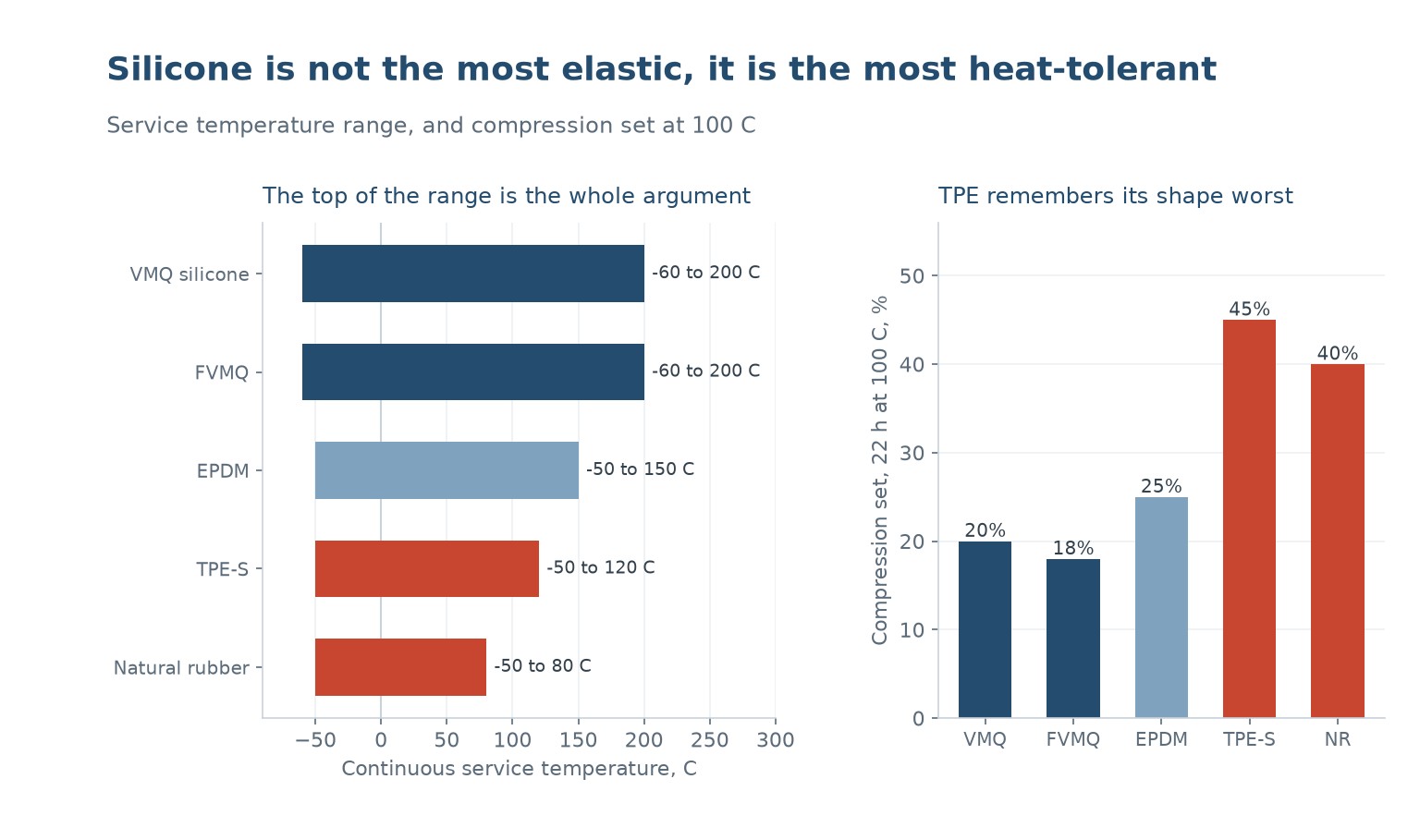
Silicone runs continuously from minus 60 to 200 degrees, and short excursions to 250. Fluorosilicone matches the low end and improves the chemical resistance. EPDM reaches 150. A styrenic TPE reaches 120 and softens progressively above 90. Natural rubber is finished at 80.
The top of the range is the whole argument. Below 100 degrees all three materials work, and the choice is made on cost, feel and processing. Above 120 the TPE is out. Above 150 only silicone and fluorosilicone remain.
| Material | Continuous range, C | What fails first |
|---|---|---|
| VMQ silicone | -60 to 200 | Gradual hardening above 200, then embrittlement |
| FVMQ | -60 to 200 | Same, with better fuel and oil resistance |
| EPDM | -50 to 150 | Oxidation and hardening above 150 |
| TPE-S | -50 to 120 | Softening of the hard domains, then flow |
| Natural rubber | -50 to 80 | Oxidation, then cracking |
Table 1 - Continuous service temperature and the failure mode at the top of the range. The failure modes are different, which matters: a TPE softens, silicone hardens.
The low end is more evenly matched than the numbers suggest. Silicone stays flexible at minus 60 but its tear strength is poor there; natural rubber stiffens and crystallises but does not crack as readily. For a cold-climate seal, the choice depends on whether the load is static or dynamic.
Compression set: where TPE loses
Compression set is the permanent deformation left after a seal is held compressed at temperature. It is the property that decides whether a seal still seals after a thousand hours, and it separates the three materials more sharply than hardness does.
At 100 degrees for 22 hours, a silicone O-ring takes 20 percent set, fluorosilicone 18, EPDM 25, natural rubber 40 and a styrenic TPE 45. The TPE number is the one that ends most TPE seal projects: the material is elastic at room temperature and creeps at 100.
The mechanism is different in each case. Silicone and EPDM set because the network relaxes and some chains rearrange permanently. Natural rubber sets because the sulphur crosslinks continue to change. TPE sets because the hard domains soften and flow, which is a physical change that no post-cure can undo.
Feel, hardness range and the limits of each
- Silicone: 10 to 80 Shore A in solid compounds, with the useful band 30 to 70. Soft grades are tacky; hard grades tear poorly. The surface is dry and slightly silky.
- TPE: 0 to 90 Shore A, and the soft end is where TPE wins. A 20 Shore A TPE is easy; a 20 Shore A silicone is difficult and has poor tear.
- Natural rubber: 30 to 90 Shore A, with the best elastic snap of the three and a characteristic rubber smell that some applications cannot tolerate.
The soft end is the reason TPE takes so much of the consumer market. A grip, a wearable band or a soft-touch housing is easier and cheaper in a 30 Shore A TPE than in a 30 Shore A silicone, and at room temperature the difference in performance is small.
The hard end goes the other way. Above 70 Shore A, silicone and natural rubber both behave like useful engineering materials and TPE starts to feel like a stiff plastic with a low softening point.
Chemical resistance: no clear winner
Silicone is poor against hydrocarbons, fuels and non-polar solvents, and good against water, alcohols and dilute acids. That is exactly the opposite of natural rubber, which swells in oils but survives some polar solvents better.
Fluorosilicone exists to fix the hydrocarbon weakness, at three to five times the price of standard silicone, and with worse low-temperature flexibility and worse tear. It is the material for fuel system seals and for aerospace, not a general upgrade.
TPE resistance depends entirely on the mid-block. A styrenic TPE swells in oils; a TPV or a TPU is much better. Specifying "TPE" without naming the chemistry is how a seal that passed a lab test swells in service.
TPE processes like a plastic. It can be injection moulded on a standard screw, it needs no vulcanisation, it produces no flash to trim if the tool is right, and the scrap can be reground. A TPE part can be moulded in a 30 second cycle on a standard machine.
Silicone needs a dedicated machine or a dedicated screw and barrel, a cold runner or a cooled sprue, and a cure time measured in minutes rather than seconds. Compression moulding of a silicone part is a 3 to 10 minute cycle. Liquid silicone injection brings that down to 30 to 60 seconds, but only with a dosing system, a cooled runner and a much higher capital cost.
Natural rubber needs mixing, milling, forming and a vulcanisation step, and it cannot be reground into the same part. It is the cheapest material and often the most expensive part.
| Silicone | TPE | Natural rubber | |
|---|---|---|---|
| Cycle time | 30 s LSR, 3 to 10 min HCR | 20 to 40 s | 2 to 10 min plus vulcanisation |
| Scrap reusable | No | Yes, up to 30 percent | No |
| Machine | Dedicated screw and barrel | Standard | Dedicated mixing line |
| Relative resin cost | 6 | 2 | 1 |
| Relative tooling cost | 2 | 1 | 2 |
Table 2 - Processing comparison. The resin cost ratio is the number buyers look at; the cycle time ratio is the number that decides the part price.
The decision, in order
Four questions, asked in this order, resolve almost every case.
- What is the maximum continuous temperature? Above 150, silicone or fluorosilicone. Between 100 and 150, EPDM or silicone. Below 100, all three are candidates.
- Is it a seal under sustained compression? If yes and the temperature is above 70, avoid TPE. If the load is intermittent, TPE is fine.
- What is the chemical environment? Hydrocarbon or fuel, use fluorosilicone or a fluoroelastomer. Water and alcohol, silicone. Oil, natural rubber or a TPV.
- What is the volume and the tolerance? High volume and tight tolerance favour LSR or TPE; low volume and large parts favour HCR compression moulding or natural rubber.
The honest summary is that silicone is specified for temperature, TPE for cost and feel, and natural rubber for elastic performance at ambient temperature. A project that specifies silicone for a 60 degree application is paying six times the material cost for a property it does not need, and a project that specifies TPE for a 110 degree seal is buying a warranty claim.
Is silicone better than TPE?
Only above about 120 degrees, and for seals under sustained compression. Below that a TPE is cheaper, tougher, easier to process and just as good, and it can be recycled.
Can TPE replace silicone in a medical device?
Sometimes, for a short contact application, with the right grade and its own biocompatibility testing. For long-term implant or repeated autoclave, silicone remains the default.
Why is silicone so expensive?
The gum is made from silicon metal through a energy-intensive route, the compound needs a dedicated mixing line, and the cure is slow. The resin cost is six times a TPE and the cycle time is often five times longer.
What is the difference between TPE and TPV?
TPV is a dynamically vulcanised TPE with crosslinked rubber domains in a plastic matrix. It has better compression set and better heat resistance than a styrenic TPE, at a higher price.
Which one is best for a food contact seal?
Silicone and TPE both have compliant grades, and both need the documentation for the specific application. Silicone tolerates higher temperatures and is easier to clean; TPE is cheaper and can be overmoulded.
Can natural rubber be used outdoors?
Poorly. It degrades under UV and ozone, and it cracks. EPDM is the outdoor elastomer, and it is what a weather seal should be made from.
Not sure which elastomer the application needs?
Tell us the temperature, the medium, the squeeze and the volume. We will tell you which family works, and whether you are about to pay for a property you do not need.




 EN
 ES
 FR
 DE
 PT
 AR
 RU
 JA
 KO
 IT
 NL
 TR
 PL
 ID
